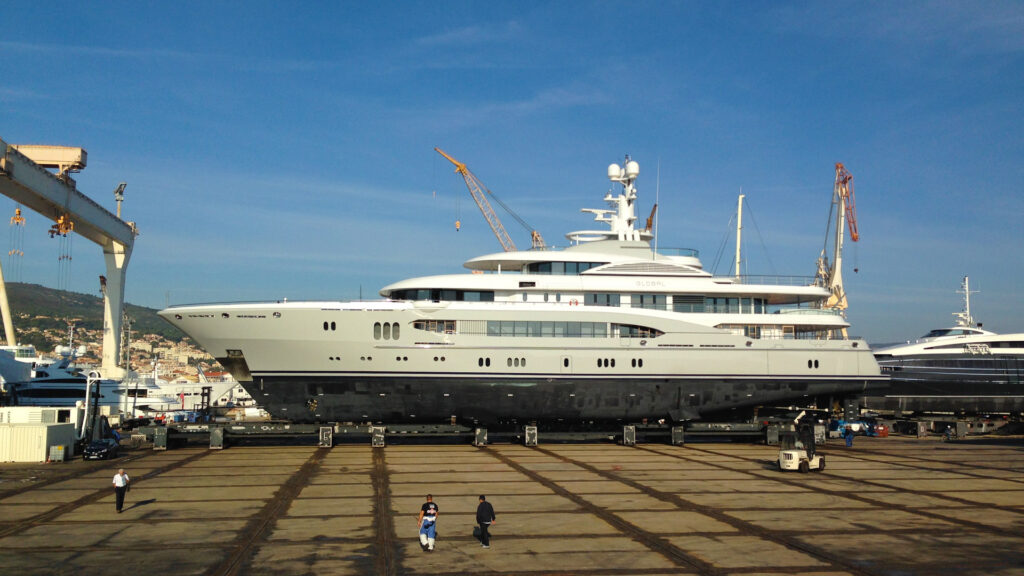
With limited production capacity and long lead times, refit has become an increasingly attractive alternative to new-build for owners who simply do not want to wait three or more years for delivery. But beyond that practical reality, refit is playing a far more important role in the future of yachting.
A Changing Landscape
The legacy fleet is ageing, and owners — existing and prospective — are facing a growing set of pressures. Future regulations and carbon tax, societal scrutiny, their personal values, are all driving a desire to reduce their yacht’s environmental footprint, cut OPEX, improve comfort, and consequently, protect charter and resale value. These are not abstract future concerns; they are real and present considerations that are already influencing purchasing decisions.
Then there is the generational shift. A new generation of ultra-high-net-worth individuals are arguably more focused on environmental issues than their predecessors. This matters for both new builds and the used market. If our industry cannot offer this generation meaningful solutions that allow them to invest in more responsible yachting, we will miss a significant opportunity for growth.
Refit, therefore, has a unique role to play — not just in keeping yachts operational, but in transforming them.
The Emissions Problem We Cannot Ignore
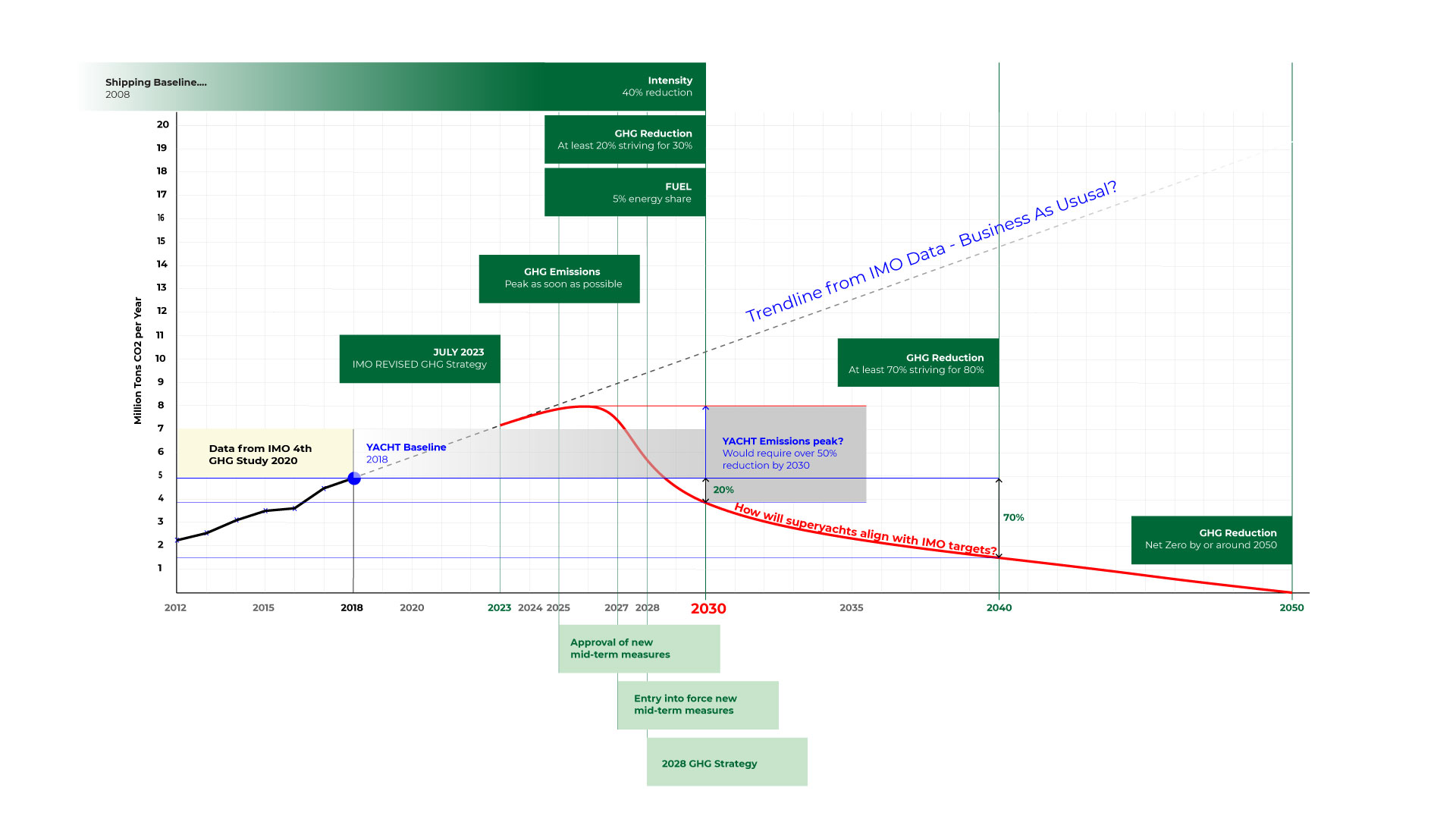
Unlike commercial shipping, which has a working life of around 20 years, a well-built and maintained superyacht can remain in service for many decades. This leads to compounding fleet growth and is one of the reasons why our industry’s emissions are on a trajectory to grow significantly, not shrink. They could reach 10Mt of CO2 annually by 2030.
Reducing emissions from the existing fleet is not optional — it is essential if yachting is to demonstrate any credible alignment with broader GHG reduction goals.
This is where refit becomes critically important. Every refit cycle is an opportunity. Whether driven by regulatory obligation, financial incentive, or an owner’s values, the scope to reduce a yacht’s environmental footprint through targeted upgrades is significant and largely untapped.
What Does This Look Like in Practice?
Solutions span a wide spectrum.
At the simpler end: applying solar film to glazing to reduce thermal load on air conditioning, changes to allow the use of HVO, switching to LED lighting, installing microplastic filters on washing machines.
More complex solutions include power management and automation, mild hybridisation for peak shaving and load balancing, advanced wastewater treatment, or even full air conditioning system upgrades.
Many of these can be phased across refit cycles, aligned to budget and available time in yard.
The key point is that no two yachts are the same. Available space, existing systems, operational profile, budget and time in yard will all determine what is feasible and beneficial. These are not solutions you can pick off a shelf — each upgrade requires proper assessment, a clear understanding of the environmental benefit, and a robust analysis of the financial case: return on investment and total cost of ownership.
The Need for Rigour — and Honesty
This is where caution is essential. There is a real risk of disappointment by presenting solutions as more impactful environmentally or cost-effective than they actually are. Owners and their advisors are rightly sceptical, and that scepticism will only grow without evidence.
Solutions must be thoroughly assessed and able to withstand scrutiny, not only on their environmental credentials but also on the financial case. Providers need to offer full transparency and, ideally, independently verified data on benefits relative to existing systems and a yacht’s actual operational profile. Without that rigour, we are simply adding noise and undermining the credibility of the whole endeavour.
The industry also needs more high-profile players to step up and take a genuine leadership role here. The conversation is happening, but the willingness to acknowledge the scale of the challenge — and to act with both ambition and pragmatism — is still lacking.
There is of course some comfort in the “business as usual” approach, but it fails to acknowledge the world is changing and we must adapt to.
Engaging the wider community, including owners, captains, managers and their advisors, requires balance: acknowledging where we fall short while offering practical, validated solutions that demonstrate positive change is achievable.
A Natural Evolution
Maintenance and refit have always extended a yacht’s useful life, its safety, comfort and value.
Climate change now adds another dimension to that equation. Builders and refit companies will increasingly need to embed efficiency and environmental upgrades into their expertise and portfolio — not as a niche add-on, but as a core service.
It is also worth noting that the normal repair-and-replace cycle itself offers a natural entry point for introducing better solutions. When a system reaches the end of its life, that is an opportunity to replace it with something more efficient.
The future of refit will be shaped by regulations, taxes, cruising restrictions, and the values of a new generation of owners. Those who are already investing in the knowledge, the partnerships, and the credibility to deliver on this — in both their own operations and the solutions they offer clients — will be well positioned to benefit from this shift.
Refit then, becomes more than maintenance; it becomes a strategic opportunity that will help drive the future growth of the industry.