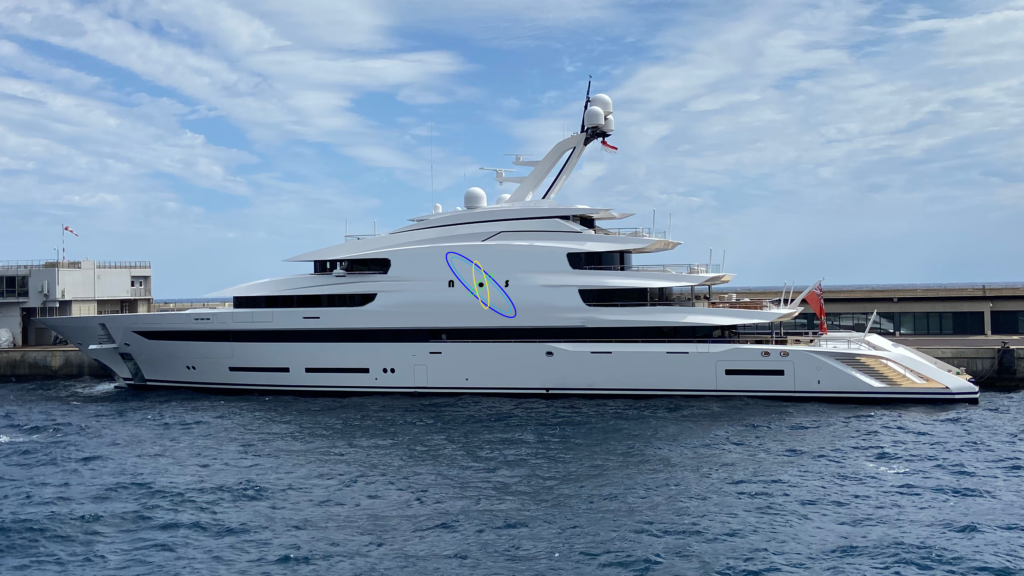
For those in the superyacht industry who are curious about nuclear, a new joint development report 'Enabling Nuclear-Powered Feeder Ships' from a consortium that includes Core Power, Maersk, LR and the Port of Rotterdam, looks at a challenge rarely discussed - port access.
Unfortunately, this joined up approach from commercial shipping is so often missing in yachting who tend to feed of hype rather than reality.
While international rules and regulations are being developed for nuclear-powered civilian vessels, national laws and approvals, as well as regional and port authority regulations, will ultimately dictate where these vessels can sail and where they can berth.
Of note, there are very few countries with nuclear safety, licensing, and regulatory authorities for land use, let alone maritime. Countries that have regulatory frameworks and operate nuclear vessels are Russia, China, Brazil, India, France, the UK, and the USA; all are restricted to naval vessels, except for Russian civilian icebreakers.
| Country | Ship types | Regulatory authority | Abbr. | Scope | Website |
|---|---|---|---|---|---|
|
🇧🇷Brazil
|
Submarine (dev.)
|
National Nuclear Energy Commission
Regulates civilian nuclear including the submarine development programme
|
CNEN | Civilian | cnen.gov.br |
|
🇨🇳China
|
Submarines
|
National Nuclear Safety Administration
Regulates civilian nuclear safety; naval reactors are under separate military oversight
|
NNSA | Civilian | nnsa.mee.gov.cn |
|
🇫🇷France
|
Submarines + carrier
|
Nuclear Safety & Radiation Protection Authority
Regulates civil nuclear. Naval reactors are overseen by the Ministry of Armed Forces (DGA/DSND)
|
ASNR | Civilian | asnr.fr |
|
🇮🇳India
|
Submarines
|
Atomic Energy Regulatory Board
Regulates all nuclear activities under the Atomic Energy Act, including naval reactor oversight
|
AERB | Civilian + Naval | aerb.gov.in |
|
🇷🇺Russia
|
Submarines + carriers
Icebreakers (9)
|
Federal Service for Environmental, Technological and Nuclear Supervision
Regulates civilian icebreakers (Rosatomflot) and supports licensing of naval construction yards. Russia is the only country with a regulated civilian nuclear ship fleet
|
Rostechnadzor | Civilian + Icebreakers | en.gosnadzor.gov.ru |
|
🇬🇧United Kingdom
|
Submarines
|
Office for Nuclear Regulation
Regulates nuclear safety at submarine construction and decommissioning sites. The Defence Nuclear Safety Regulator (DNSR) within the MoD regulates submarines in operation
|
ONR | Civilian + Shipyards | onr.org.uk |
|
🇺🇸United States
|
Submarines + carriers
|
Naval Reactors (DOE / Navy joint programme)
Naval reactors are self-regulated under Naval Reactors, a joint DoD/DOE programme. The NRC regulates only civilian nuclear; it has no authority over naval reactors
|
Naval Reactors | Naval (DoD/DOE) | navalreactors.navy.mil |
Sources: World Nuclear Association, IAEA Country Nuclear Power Profiles, NIA, ONR, NRC — June 2026. In most countries, naval nuclear reactors are regulated internally by defence ministries rather than civilian nuclear safety authorities. Australia (AUKUS) is not yet included — it plans to acquire nuclear-powered submarines from approximately 2032.
Interestingly, none of the popular Flag States such as Cayman Islands, Marshall Islands or Malta are in either list. That raises some serious questions about how they would regulate nuclear yachts under their flags.
This makes approval from coastal authorities and ports a significant hurdle to overcome, especially when safety and public perception are factored in. For popular yachting anchorages and marinas that are often in populated areas, it will be even harder - especially given the public perception of yachting and the spate of fires we have seen in recent times.
The roll-out of nuclear in commercial shipping will follow the path of innovation adoption cycles; it will be slow and cautious until there is confidence in the technology, its cost and, above all, safety. During that time nuclear ships will be restricted to specific countries and ports.
There are some in our industry who are suggesting we could see a nuclear yacht in the next five years. Technically, I think this is a stretch, but even if it did happen, I have seen no coherent explanation of where this yacht would be able to sail and berth.
A nuclear yacht in the short term would be a technical marvel, but very likely it would also be an expensive 'stranded asset' with nowhere to go.